
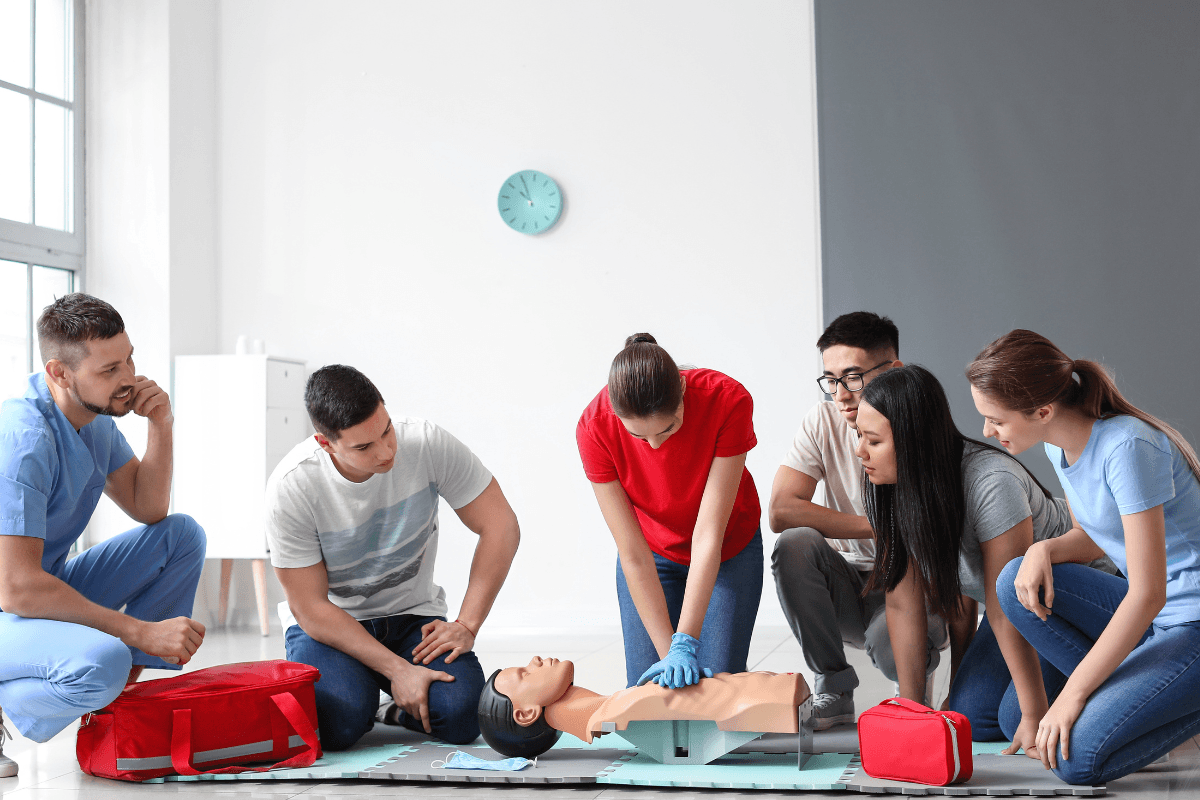
National CPR and AED Awareness Week highlights what to do when seconds matter. This guide explains simple steps, essential equipment, and training options so more people can act quickly and safely during a cardiac emergency.
Key Takeaways
- Immediate action first: call, compress, defibrillate.
- Use clear steps to start chest compressions.
- AEDs coach you; follow prompts.
- Practice beats perfection during emergencies.
- Plan drills and maintain equipment routinely.
Why Immediate Action Saves Lives
When the heart suddenly stops, oxygen to the brain falls within seconds. Rapid recognition and action can double or triple survival, especially when chest compressions and defibrillation start early. The concept behind this is the chain of survival, which links early recognition, high-quality CPR, rapid defibrillation, advanced care, and recovery. Each link matters because delays quickly reduce the chance of a meaningful recovery.
Evidence-based guidance from the American Heart Association outlines these steps and their impact; see the chain of survival for concise definitions and sequence clarity (AHA chain overview). For a deeper Canadian perspective on preparedness and community programs, the Heart & Stroke Foundation provides practical resources on planning and training (Heart & Stroke Canada resources).
Understanding cardiovascular conditions also helps teams plan prevention and response drills. For broader disease context and risk factors, see Cardiovascular Articles for topic overviews and trends. If you want a snapshot of common therapies that patients may use, review Cardiovascular Medications for background on typical treatment classes.
What Is National CPR and AED Awareness Week?
This observance focuses on public readiness to respond to sudden cardiac arrest (SCA). Communities use it to run drills, refresh skills, and expand access to defibrillators in public spaces. Schools, workplaces, and local groups often coordinate short practice sessions and invite certified instructors. These activities reinforce recognition, response, and recovery, which together support survival and long-term outcomes.
Organizers typically highlight adult, teen, and school-based interventions. Many provide quick demonstrations of compression-only techniques alongside device familiarization. You might also see short talks on recognizing SCA, identifying safe device placement zones, and assigning roles during emergencies. Simple checklists, posted near devices, guide bystanders when stress is high.
Hands-Only CPR: Steps and Safety
Starting chest compressions quickly keeps blood moving to the brain. For teens and adults who suddenly collapse and do not respond, hands-only cpr is a practical, effective method. Push hard and fast in the center of the chest, allowing full recoil between compressions. If someone can call emergency services on speakerphone, they should do so while you continue compressions.
Use music beats or metronomes to help maintain the appropriate pace. Avoid leaning on the chest; full recoil lets the heart refill. Switch compressors if someone tires, ideally every two minutes. For background technique and safety reminders, the American Heart Association provides straightforward guidance on adult-only compression methods (AHA guidance on Hands-Only CPR).
Technique Pointers and Common Variations
Position your hands on the lower half of the sternum. Keep your shoulders over your hands and your elbows locked to drive compressions vertically. On a firm surface, compress to the recommended depth and rate, minimizing interruptions. If a barrier device is available and you are trained, you may add rescue breaths. Untrained bystanders should focus on compression-only methods until advanced help arrives.
Consider space, clothing, and hazards. Remove thick jackets to find the sternum quickly. If the person is in a dangerous area, move them only if safe to do so. Assign one person to watch for help and, if available, to bring a defibrillator promptly.
How to Use an AED: Simple, Safe, Effective
Automated external defibrillators analyze heart rhythm and guide users through clear voice prompts. If the device advises a shock, it will prompt you to stand clear and press the button. When no shock is advised, follow the voice prompts and resume compressions. These devices are designed for laypeople; follow instructions step by step without overthinking.
Turn the device on, expose the chest, and apply the pads as shown on the illustrations. If the chest is wet, dry it quickly; if very hairy, use the kit razor to improve pad contact. Keep metal jewelry away from pad areas, and place the device on a stable surface. For a broader overview of device role and public programs, see AED Awareness for placement and access considerations.
AED Maintenance Checklist
Effective programs rely on working equipment. Create a simple log that tracks pad expiration dates, battery status, and visible damage. Assign a named owner for weekly visual checks and monthly functional checks. Keep spare pads and a battery on hand if the model permits, and store scissors, gloves, a razor, and a wipe in the case. After any use, replace consumables and document the event for quality review.
Local regulations or workplace policies may specify additional requirements. Many manufacturers outline routine checks in their manuals, and some provide remote monitoring tools. The Heart & Stroke Foundation offers public placement considerations and training support that can guide maintenance priorities (AED program guidance).
Training, Certification, and Community Readiness
Short, practical classes help people work as a team during emergencies. Decide whether your audience needs basic familiarity or a credential that meets regulatory or workplace standards. For individuals seeking a flexible pathway, cpr certification vs training can be weighed by time, cost, and local requirements. Blended models often combine concise online modules with brief, hands-on skills checks.
Coordinate with local instructors, community centers, or school districts to host courses. Many programs include aed training modules and scenarios that mirror real-world settings. Consider accessibility, language support, and visual aids for diverse participants. Post simple, laminated guides near devices and in high-traffic areas, and schedule routine refreshers to fight skill decay.
Workplace and School Programs
Identify likely responders such as security staff, coaches, and teachers. Provide role cards during drills—caller, compressor, AED runner, and crowd coordinator—to reduce confusion. Map device locations and include them on safety posters and campus apps. Encourage students to practice skills under supervision; teens can perform effective compressions and call for help. Document participation and maintain a roster so each shift or team has trained people on site.
Some staff may also take medications for heart or blood pressure conditions. For context on post–heart-attack beta blockers used in cardiology, see Carvedilol for dosage forms and cautions. For another common agent with cardiac uses, see Propranolol HCl for clinical background and monitoring notes. When calcium channel blockers are discussed in return-to-work planning, see Verapamil for typical indications and interactions.
Planning for Awareness Days and Months
Use calendar touchpoints to refresh knowledge and promote drills. During cpr awareness month 2025, schedule quick, daily skills rotations in public spaces. Pair short compressions practice with device familiarization and poster updates. Offer brief talks on recognizing cardiac arrest and coordinating roles across teams.
Broaden engagement beyond a single event. Feature cardiovascular risk reduction talks during first aid awareness month and highlight device access during aed awareness month. Link messaging to community health priorities and local statistics. If your community addresses diabetes-related heart risks, this piece on Diabetes–Heart Connection Day can contextualize prevention efforts for high-risk groups.
Key Safety Tips and Common Mistakes
Clear hazards before touching the person. If water or conductive surfaces are present, move to a safer area before using a device. Avoid stacking tasks; assign roles quickly so compressions do not pause. Keep compressions deep and continuous, and minimize interruptions for checks or device steps. Post simple checklists on cabinets to guide new responders.
Standardized reminders help prevent errors under stress. Include cpr and aed safety tips on posters and pocket cards. Emphasize calling emergency services early and placing the device pads exactly as pictured. If your facility has medically complex populations, consider tailored drills and add equipment notes. For diuretics and blood pressure management considerations in risk reduction talks, see Hydrochlorothiazide for typical use and precautions. Where vision or migraine therapies overlap with cardiovascular care, see Timolol or Nimotop for background when planning staff education.
Recap
Rapid recognition, compressions, and defibrillation save lives. Plan drills, maintain devices, and offer short, practical classes that people can complete. Use calendar campaigns to refresh skills across schools, workplaces, and community spaces. Small, consistent steps build confident bystanders and stronger outcomes.
This content is for informational purposes only and is not a substitute for professional medical advice.


