
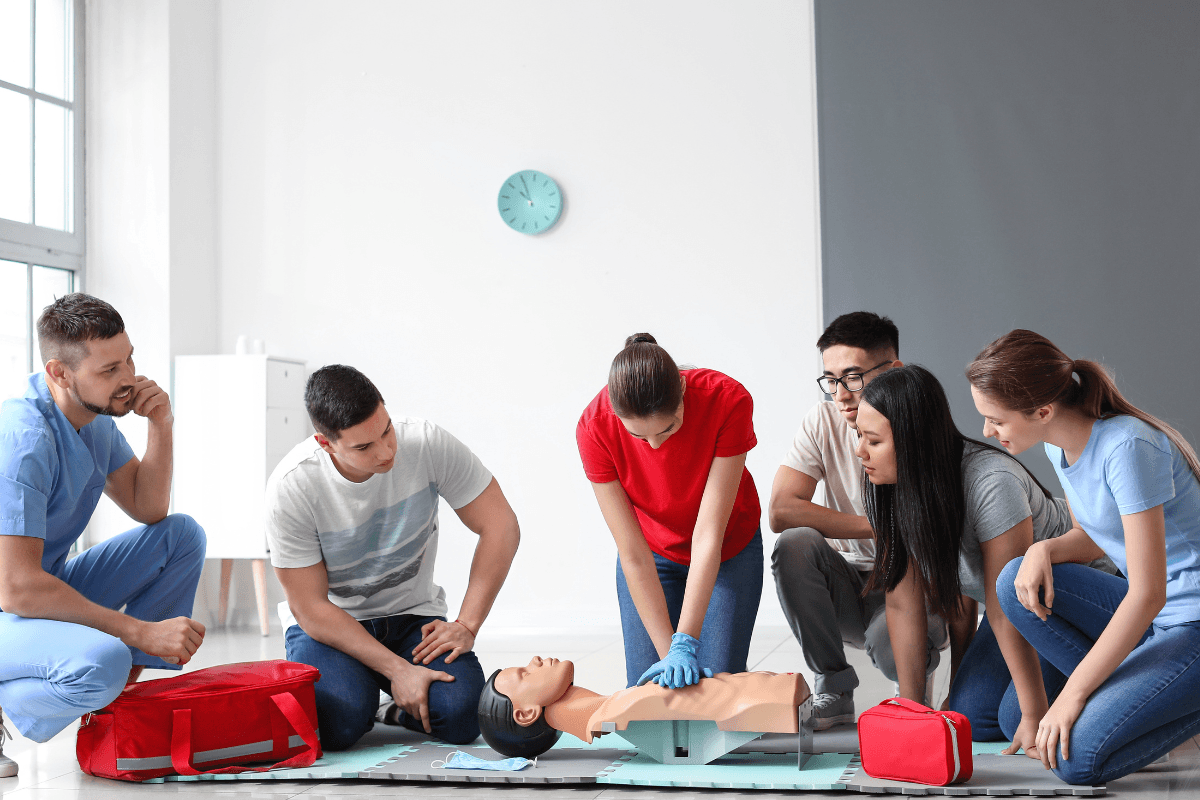
National CPR and AED Awareness Week is an annual reminder that fast bystander action can save a life during sudden cardiac arrest. If someone collapses, is unresponsive, and is not breathing normally, the practical response is to call emergency services, start CPR right away, and use an automated external defibrillator (AED) as soon as one is available. That matters because the brain and heart can go without oxygen for only a short time, and the first few minutes often pass before professionals arrive.
Key Takeaways
- CPR and AED Awareness Week focuses on simple skills ordinary bystanders can learn.
- Suspect cardiac arrest when a person is unresponsive and not breathing normally or is only gasping.
- For most collapsed teens and adults, hands-only CPR means hard, fast chest compressions in the center of the chest.
- An AED gives voice prompts and should be used as soon as it reaches the scene.
- Awareness helps people start; formal training adds confidence and a wider skill set.
What CPR and AED Awareness Week Highlights
CPR and AED Awareness Week is observed June 1-7 in the United States. The point is not to make every bystander an expert. The point is to make a few critical actions familiar enough that people can start them under stress.
The week centers on sudden cardiac arrest, which is not the same as a heart attack. A heart attack usually means blocked blood flow to the heart muscle. Cardiac arrest means the heart has stopped pumping effectively, so the person becomes unresponsive and stops breathing normally. CPR can move some blood to the brain and heart. An AED checks the rhythm and may advise a shock when that is appropriate.
Bystander CPR and early AED use work best together. One action helps buy time. The other may address the dangerous rhythm that caused the collapse in the first place.
Why it matters: The first minutes after collapse are often the most important.
Recognizing Cardiac Arrest in the First Minute
Cardiac arrest should be suspected when a person suddenly collapses, does not respond, and is not breathing normally or is only gasping. Lay rescuers do not need to spend time on a long pulse check if they are unsure. The safer move is to treat it as an emergency and get the response started.
Begin with a quick scene check. If the area seems safe, tap the person and shout. If there is no response, call emergency services or direct a specific bystander to call. Ask another person to bring the nearest AED if one is available. If you are alone and have a phone, use speaker mode so the dispatcher can guide you while you begin compressions.
Expose the chest enough to place your hands in the middle of the chest. If an AED arrives, you will also need enough exposure for pad placement. Do not lose time trying to create perfect conditions before starting.
A simple first-minute sequence
- Check for responsiveness and normal breathing.
- Call emergency services and ask for an AED.
- Begin chest compressions immediately.
- Use the AED as soon as it arrives.
- Resume CPR after any shock or analysis prompt.
Site note: CanadianInsulin.com functions as a prescription referral platform.
Hands-Only CPR: The Adult Technique to Remember
For most teens and adults who collapse suddenly, hands-only CPR means continuous chest compressions without rescue breaths. Public campaigns often emphasize this approach because it is easier to remember, easier to start, and more likely to be used by someone who has never taken a class.
Kneel beside the person. Put the heel of one hand in the center of the chest, place your other hand on top, lock your elbows, and push straight down. Aim for hard, fast compressions at a rate of about 100 to 120 per minute. For adults, the chest should compress about 2 inches deep, with full recoil between pushes. Try to minimize pauses.
If another bystander is available, switch compressors when fatigue starts to affect depth or pace. Even strong rescuers tire quickly, and shallow compressions are less helpful than consistent ones.
| Approach | Often used when | Main focus |
|---|---|---|
| Hands-only CPR | Untrained or lightly trained bystander helping a collapsed teen or adult | Continuous chest compressions |
| CPR with breaths | Trained rescuer, or situations such as children, drowning, or breathing-related arrest | Compressions plus rescue breaths |
Breathing-related emergencies can be different from sudden adult collapse. Children, infants, drowning victims, overdose cases, or people whose arrest followed a breathing problem may benefit from rescue breathing when a trained rescuer is present. If you are not trained, start compressions and follow dispatcher guidance.
Why CPR and AED Use Work Together
CPR and an AED do different jobs. CPR buys time by moving a small but important amount of blood through the body. The AED looks for a shockable rhythm and, if appropriate, delivers defibrillation (an electrical shock meant to reset certain dangerous rhythms). One does not replace the other.
This is why public AED access matters in airports, schools, offices, gyms, stadiums, and apartment buildings. A bystander may start CPR immediately, but a nearby AED can address a rhythm problem that compressions alone cannot fix. In many settings, early CPR and early defibrillation are meant to happen together.
You should not wait for the device before starting compressions. If the AED is not already in your hands, begin CPR first and switch to pad placement as soon as someone brings the device.
How to Use an AED Safely and Quickly
An automated external defibrillator is built for lay use. Most devices give spoken directions and visual prompts, so the best response is to turn it on quickly and follow the instructions step by step.
- Turn on the AED as soon as it reaches the person.
- Expose the chest and dry it if it is wet.
- Attach the pads exactly as shown on the pad diagrams.
- Make sure no one is touching the person during rhythm analysis.
- If the device advises a shock, stand clear and deliver it.
- Resume CPR immediately after the shock, or if no shock is advised.
AED pad placement basics
For a typical adult setup, one pad goes on the upper right chest and the other goes on the lower left side of the chest. The images on the pads are the fastest guide in the moment. If child pads are available for a pediatric emergency, use them and follow the device prompts.
A few safety details matter. Move the person away from standing water if possible, and dry the chest before attaching pads. Do not let anyone touch the person while the AED analyzes or shocks. If there is a visible implanted device bulge under the skin, place the pad slightly away from it rather than directly on top.
Remove or cut away only as much clothing as needed to expose the chest. The goal is not neatness. The goal is fast hand placement for CPR and firm pad contact for the AED.
Common Questions That Stop People From Acting
Most hesitation comes from uncertainty, not lack of concern. A few practical clarifications can make the next step easier when the scene feels chaotic.
If the person is gasping, making irregular snorting sounds, or taking occasional abnormal breaths, do not assume they are stable. Agonal breathing can happen in cardiac arrest and should be treated as an emergency.
If you worry about hurting the person, remember that doing nothing during true cardiac arrest is the larger risk. Emergency dispatchers can guide you, and AEDs are designed not to deliver a shock unless the rhythm meets the device criteria.
If you are alone, place the phone on speaker if possible, then start compressions. If other people are nearby, give one person a direct task to call emergency services and another to get the AED. Specific instructions reduce the common freeze response.
Example: A coworker collapses near the break room and does not respond when spoken to. One person calls emergency services, another brings the lobby AED, and the nearest bystander starts compressions. No one waits for a perfect diagnosis before acting.
National CPR and AED Awareness Week exists partly to remove this pause. The goal is not flawless technique under pressure. It is faster recognition and earlier action.
Awareness Is Not the Same as Full CPR Training
Awareness campaigns help people start. They do not replace hands-on practice with an instructor. A poster, article, or short video can help you remember the broad sequence, but it cannot correct hand position, pace compressions, or coach you through a child emergency.
Formal CPR and AED training usually covers more than adult cardiac arrest. It may include rescue breathing, infant and child technique, choking response, AED troubleshooting, team communication, and how to rotate rescuers with minimal pause time. Those details matter when the emergency is not a straightforward adult collapse in a public place.
If you care for someone with heart disease, or you want broader heart-health reading, the Cardiovascular Hub brings together related education. Awareness is the starting point. Repetition and training are what make the response feel usable under stress.
Use Awareness Week to Build a Simple Response Plan
The most practical use of an awareness campaign is preparation before the emergency happens. A short review now can make the first minute feel much less overwhelming later.
- Learn the signs: unresponsive, not breathing normally, gasping.
- Know the sequence: call, compress, AED.
- Find local AEDs: workplace, gym, school, apartment lobby.
- Take a class: formal training builds muscle memory.
- Practice aloud: rehearse the steps with family or coworkers.
- Use your phone: save access details for buildings you use often.
- Refresh skills: review them again before you need them.
Quick tip: Learn where the nearest AED is in the places you visit most.
Even a brief practice session helps. Say the steps out loud. Picture where you would stand, who would call, and where the AED might be stored. That kind of mental rehearsal makes hesitation less likely.
Formal classes still matter. Awareness introduces the basics, but training makes those basics more reliable when stress, noise, and fatigue enter the picture.
Site note: Where permitted, licensed third-party pharmacies handle dispensing and fulfilment.
Authoritative Sources
- For the official awareness-week overview, see the American Heart Association CPR and AED Awareness Week page.
- For step-by-step public instruction, review the American Red Cross CPR steps page.
- For device basics and safety information, read the FDA page on automated external defibrillators.
Further reading: awareness works best when it turns into a simple habit you can recall under pressure: recognize collapse, call for help, start compressions, and use an AED without delay.
This content is for informational purposes only and is not a substitute for professional medical advice.