
Please note: a valid prescription is required for all prescription medication.
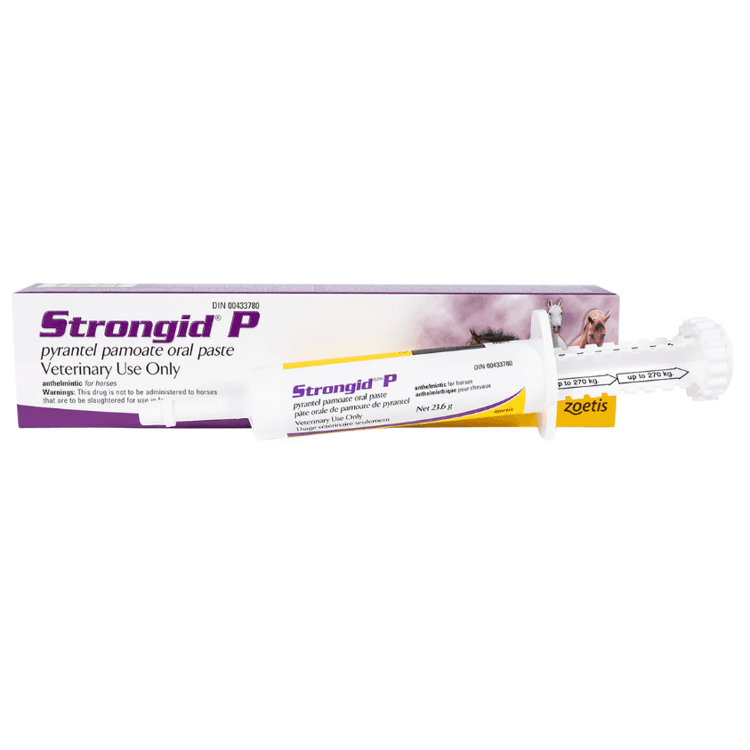
Strongid P
Buy Strongid P Horse Wormer Online


Strongid P is an equine dewormer paste containing pyrantel pamoate for horses. You can buy Strongid P online, view the current price, and choose the quantity shown during ordering to match your veterinarian’s parasite-control plan. Use the product name, active ingredient, form, horse weight, and treatment schedule together when deciding whether this horse wormer paste fits the plan for your stable.
Strongid P horse wormer is used for susceptible intestinal parasites listed on the product label, including mature infections of large strongyles, small strongyles, pinworms, and large roundworms. It does not contain ivermectin, moxidectin, or fenbendazole. That distinction matters because dewormer classes are not interchangeable, and repeated or poorly timed treatment can affect parasite control and resistance management.
Strongid P Price and Quantity Selection
The Strongid P price is shown during ordering and can change with the quantity placed in the cart. For horse wormer paste, the total tube contents and the amount used for one horse are not the same decision. A veterinarian may base the plan on current weight, fecal egg count results, age, travel history, season, and the parasite risk at the barn.
When reviewing Strongid P cost, match the product name and active ingredient first, then consider how many units are needed for the current plan. Avoid comparing only the tube shape or a general horse dewormer label. Pyrantel pamoate paste belongs to a different drug class than ivermectin products and benzimidazole products, so the cheapest similar-looking paste may not be the right choice.
| Ordering detail | How to use it |
|---|---|
| Brand and active ingredient | Match Strongid P and pyrantel pamoate to the veterinary plan. |
| Form | Use paste only when an oral equine paste is intended. |
| Horse weight | Base dosing decisions on a reliable current estimate. |
| Quantity | Choose enough units for the directed horses and timing. |
| Barn records | Compare with recent dewormers and fecal testing notes. |
Quick tip: Keep a written barn record beside you while choosing quantity, especially when several horses follow different schedules.
How to Order Strongid P Online
Order Strongid P online by choosing the product and quantity that match the written deworming plan. If your veterinarian specified Zoetis Strongid P, pyrantel pamoate paste, or a particular dewormer class, use those details rather than substituting another paste. We may review order details when needed to help the order match the information provided.
For customers using US shipping from Canada, enter the delivery information carefully and read any handling notes shown during checkout. Do not rely on a past order if a horse’s weight, health status, parasite test results, or stable exposure has changed. Deworming is most useful when it fits a current parasite-control program rather than a habit-based calendar.
Cash-pay ordering can be practical for barns that maintain separate animal-health records, but the product choice should still come from a veterinary plan. If several horses are being treated on the same day, label each horse’s record with the date, product name, active ingredient, and amount used according to the label or clinician instructions.
What Strongid P Treats in Horses
Strongid P dewormer is used in horses for the removal and control of susceptible intestinal worms named on official product information. Label targets include mature infections of large strongyles, small strongyles, pinworms, and large roundworms. These parasites can affect condition, appetite, growth in young horses, manure quality, and overall gastrointestinal health.
Large roundworms are a particular concern in foals and young horses because heavy burdens can create serious intestinal problems. Pinworms may cause tail rubbing and irritation, although environmental management is also important. Strongyles are a major focus in adult horse parasite programs, and the timing of treatment often depends on fecal egg counts and local resistance concerns.
Tapeworm questions should go back to the veterinarian. Some pyrantel-based programs may address tapeworm concerns under specific directions, but that decision depends on label directions, the dose plan, regional practice, and the horse’s risk profile. Do not change the amount or repeat treatment early to target a different parasite unless a veterinarian specifically directs it.
The intestinal worms product category can help you browse parasite-related items, but it should not replace fecal testing or a veterinary diagnosis. Parasite signs can overlap with dental disease, feed changes, ulcers, colic risk, and other gastrointestinal conditions.
Active Ingredient and How It Differs from Ivermectin
The active ingredient in Strongid P is pyrantel pamoate. Pyrantel is an anthelmintic, meaning a parasite medicine. It affects susceptible worms’ neuromuscular function so they are expelled from the horse’s digestive tract. This mechanism differs from ivermectin, moxidectin, and fenbendazole, which is why dewormer rotation should be planned rather than improvised.
Strongid P does not contain ivermectin. That answer is important for horse owners trying to avoid duplicating the same class or trying to follow a veterinarian’s rotation plan. Ivermectin-based products may have different parasite coverage, safety considerations, and timing recommendations. A pyrantel pamoate paste should not be treated as a broad substitute for every equine parasite concern.
Class choice also matters for resistance management. Treating every horse on a fixed routine without testing can increase unnecessary exposure. Many barns now use fecal egg count testing, targeted treatment, pasture hygiene, and quarantine planning for new arrivals. Strongid P may be one tool in that approach when its labeled use fits the case.
Dose and Schedule Questions to Confirm
Strongid P dosage should follow the product label and the veterinarian managing the horse. Do not estimate from another horse’s tube setting, a barnmate’s routine, or an old schedule. Body weight is a central factor, and a weight tape, scale, or recent veterinary record is more reliable than a visual estimate.
If the paste tube has weight markings, use them exactly as the label describes. Underdosing can reduce parasite control and may contribute to resistance pressure. Unnecessary repeat dosing can increase the chance of adverse effects and may disrupt a more targeted barn program. Accurate dosing is especially important in foals, thin horses, debilitated horses, and animals with heavy parasite burdens.
Ask your veterinarian how Strongid P fits with fecal egg count testing. Some horses shed more parasite eggs than others and may need a different schedule. Others may not require treatment at every traditional interval. Travel, shows, breeding facilities, shared pastures, and new arrivals can all change the plan.
- Current weight: Update the estimate before measuring paste.
- Recent dewormers: Record ingredient names, dates, and amounts used.
- Target parasite: Match the product to the worms being addressed.
- Follow-up testing: Ask whether a fecal egg count reduction check is needed.
- Stable factors: Include manure removal, pasture rotation, and stocking density.
Safety, Side Effects, and When to Call a Veterinarian
Most horses tolerate pyrantel pamoate products when used according to label directions, but side effects can occur. Watch for unusual drooling, sweating, diarrhea, abdominal discomfort, weakness, swelling, hives, breathing difficulty, or marked behavior changes. Some reactions may relate to the horse’s health, parasite burden, or another medicine rather than the paste alone, so significant signs need veterinary follow-up.
Can Strongid P cause colic? Colic signs can occur around deworming for several reasons, including an underlying gastrointestinal problem, heavy parasite burden, diet change, stress, or medication reaction. Call a veterinarian promptly if the horse paws, rolls, repeatedly looks at the flank, stops passing manure, refuses feed, becomes depressed, or shows worsening abdominal pain.
Ask before using this equine dewormer paste in foals, pregnant or nursing mares, geriatric horses, thin or debilitated animals, or horses with fever, severe diarrhea, poor appetite, or active colic signs. Also tell the veterinarian about recent dewormers, supplements, insecticides, sedatives, anti-inflammatory medicines, and any other drugs. Combining dewormers or repeating treatment early without direction can create avoidable risk.
Competition and food-chain rules may apply outside ordinary stable use. If a horse competes, travels internationally, or could enter a regulated food chain, confirm withdrawal intervals and governing-body restrictions before treatment. These requirements are separate from the online ordering process and may vary with the animal’s intended use.
Storage and Stable Handling
Store Strongid P paste according to the package label. Keep it in a clean, dry place away from children, pets, feed bins, and direct heat. Do not use a tube if the seal is broken, the paste appears contaminated, or the label can no longer be read. Keeping the original package with the tube helps prevent ingredient mix-ups in busy barns.
Stable handling should be organized before treatment day. If multiple horses receive dewormer, write down the horse name, product, date, estimated weight, and amount used. Use a separate plan for each animal rather than assuming all horses on the property need the same product at the same time.
Travel can complicate parasite control. Horses moving between barns, shows, quarantine areas, and breeding facilities may need fecal testing or a different schedule. Keep Strongid P with other animal-health supplies only if it fits the current stable protocol, and avoid building a stockpile of dewormers that may not match future test results.
Related Equine and Pet Dewormer Decisions
Strongid P is an equine paste, so species matters. Do not use a horse-labeled wormer for dogs, cats, livestock, or other animals unless a veterinarian specifically directs an appropriate product and plan. Animal size, species sensitivity, parasite target, and labeled use can differ substantially.
When the veterinarian recommends a different pyrantel presentation or daily program, focus on the exact active ingredient, form, and schedule. Paste products and daily pyrantel products may serve different roles. If the plan calls for another dewormer class, compare the active ingredient and label directions rather than relying on brand familiarity.
For broader browsing, the pet medications category includes animal-health products that may support prescribed care plans. Use category browsing to organize product choices, not to self-diagnose parasite problems or replace a fecal testing plan.
Authoritative Sources
Official product information should guide active ingredient checks, labeled parasite targets, and handling directions. Use these sources with your veterinarian’s instructions when deciding how Strongid P fits an individual horse or barn program.
- Zoetis Strongid Paste information.
- Zoetis Canada Strongid P details.
- DailyMed Strongid pyrantel pamoate paste label.
This content is for informational purposes only and is not a substitute for professional medical advice.
BMI Calculator
Estimate adult body mass index from height and weight, with metric and imperial units.
BMI
-
kg/m2 equivalent
Category
-
Adult screening range
These calculations are for education only and do not replace clinical advice, diagnosis, or treatment. Always confirm medical decisions with a qualified healthcare professional.
Calorie & TDEE Calculator
Estimate resting energy needs and daily calorie range from age, sex, body size, and activity level.
Hold Ctrl or Cmd to select more than one calculator.
BMR
-
estimated calories/day at rest
Maintenance
-
BMR multiplied by activity
Weight loss guide
-
maintenance minus 500 kcal/day
These calculations are for education only and do not replace clinical advice, diagnosis, or treatment. Always confirm medical decisions with a qualified healthcare professional.
Protein Intake Calculator
Estimate daily protein grams from body weight and nutrition goal.
Daily protein
-
grams/day
Per meal
-
daily target divided by meals
Protein calories
-
4 kcal per gram
These calculations are for education only and do not replace clinical advice, diagnosis, or treatment. Always confirm medical decisions with a qualified healthcare professional.
Weight Loss Timeline Calculator
Estimate a simple timeline from current weight, goal weight, and average daily calorie deficit.
Estimated weekly change
-
based on 3,500 kcal per lb
Estimated time
-
simple arithmetic estimate
Approx. date
-
if average deficit is maintained
These calculations are for education only and do not replace clinical advice, diagnosis, or treatment. Always confirm medical decisions with a qualified healthcare professional.
Weight-Loss Progress Calculator
Track percentage body-weight change and progress toward a target weight.
Weight change
-
current vs starting weight
Body weight change
-
percent of starting weight
Goal progress
-
change achieved toward goal
These calculations are for education only and do not replace clinical advice, diagnosis, or treatment. Always confirm medical decisions with a qualified healthcare professional.
Express Shipping - from $29.99
Shipping with this method takes 3-5 days
Prices:
- Dry-Packed Products $29.99
- Cold-Packed Products $39.99
Standard Shipping - $19.99
Shipping with this method takes 5-10 days
Prices:
- Dry-Packed Products $19.99
- Not available for Cold-Packed products
What does Strongid P treat in horses?
Strongid P is used in horses for susceptible intestinal parasites listed on official product information, including mature infections of large strongyles, small strongyles, pinworms, and large roundworms. A veterinarian can confirm the target parasite with fecal testing and stable history.
Does Strongid P contain ivermectin?
No. Strongid P contains pyrantel pamoate, not ivermectin. Pyrantel products belong to a different dewormer class, so do not substitute them for ivermectin or another paste unless your veterinarian says the change fits the parasite-control plan.
What is the active ingredient in Strongid P?
The active ingredient is pyrantel pamoate, an anthelmintic used to remove susceptible worms from the horse’s intestinal tract. Match the active ingredient and form to the veterinarian’s instructions before choosing quantity.
Can Strongid P cause colic signs?
Colic signs can occur around deworming because of several factors, including parasite burden, underlying gastrointestinal disease, stress, or a medication reaction. Call a veterinarian promptly if a horse shows abdominal pain, rolling, pawing, poor appetite, depression, or reduced manure output.
How should Strongid P dosage be decided?
Use the product label and the veterinarian’s directions. Current body weight, age, fecal egg count results, recent dewormers, health status, and stable risk all matter. Do not copy another horse’s dose or repeat treatment early without veterinary direction.
Rewards Program
Earn points on birthdays, product orders, reviews, friend referrals, and more! Enjoy your medication at unparalleled discounts while reaping rewards for every step you take with us.
You can read more about rewards here.
POINT VALUE
How to earn points
- 1Create an account and start earning.
- 2Earn points every time you shop or perform certain actions.
- 3Redeem points for exclusive discounts.
You Might Also Like
Select options
This product has multiple variants. The options may be chosen on the product page
Select options
This product has multiple variants. The options may be chosen on the product page
Select options
This product has multiple variants. The options may be chosen on the product page
Select options
This product has multiple variants. The options may be chosen on the product page